
A Dutch transom window from 'De Gekroonde Haan' soap factory in Leiden
- Period:
- 18th century
- Dimensions:
- 110 x 126 cm
- Reference:
- 100-874
sold
- Share
A Dutch transom window from 'De Gekroonde Haan' soap factory in Leiden
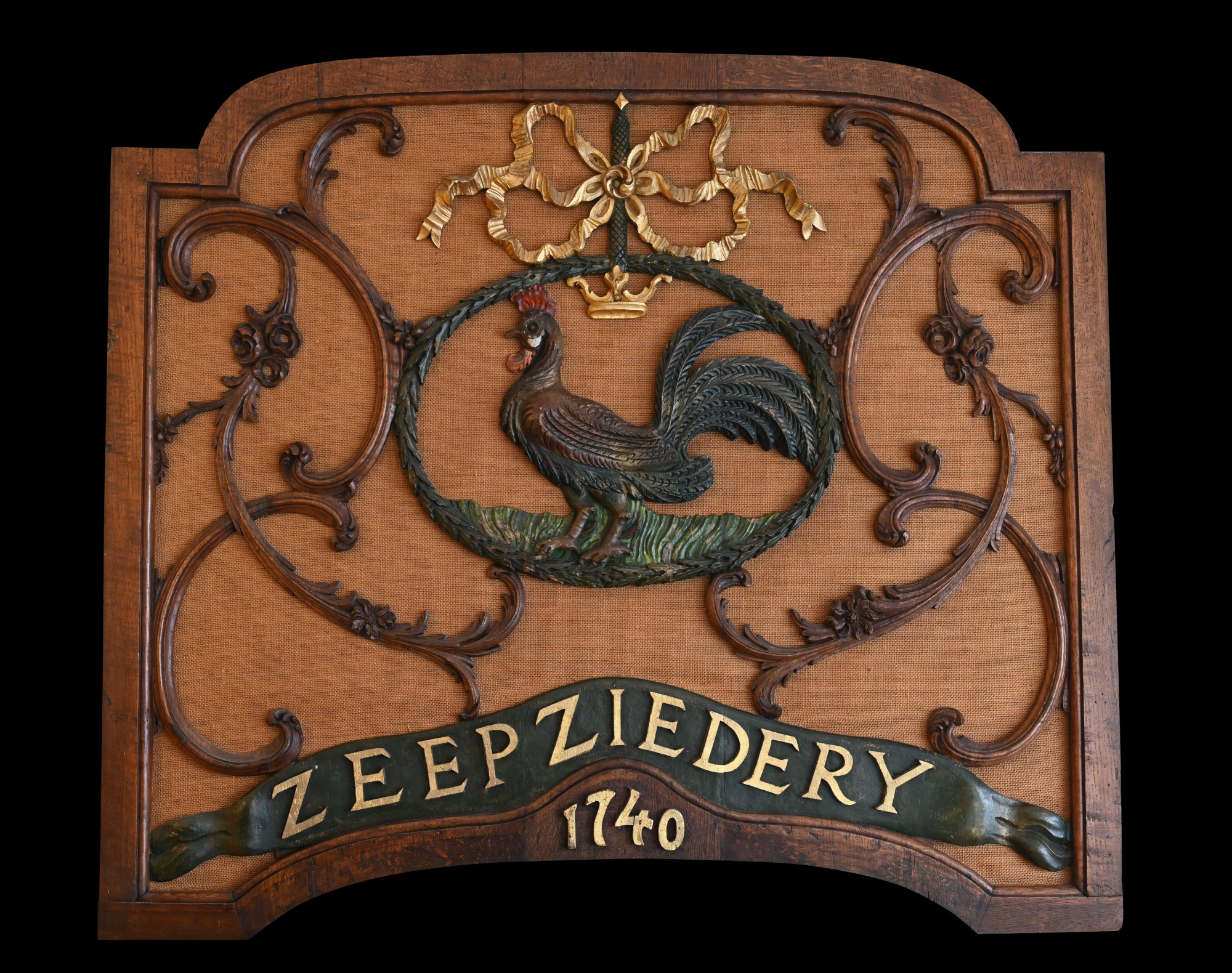
In 1740, the soap factory De Gekroonde Haan ("The Crowned Cockerel") was founded. The soap works was located on the Middelstegracht in Leiden. In 1826, Cornelis Dros (Nigtevecht, July 3, 1800 – Leiden, May 1, 1874) and his brothers-in-law Caspard Tieleman (Leiden, September 19, 1806 – June 21, 1828) and Adrien Tieleman (Leiden, November 26, 1807 – May 31, 1884) purchased the soap factory. After the death of Caspard Tieleman, Cornelis Dros and Adrien Tieleman continued running the factory and expanded it into one of the largest soap manufacturers in the Netherlands.
In 1910, the factory was partially destroyed by a fire. It was relocated and reopened on May 1, 1912, at Zoeterwoudseweg 3. The premises on the Middelstegracht were taken over by the firm Tieleman and Dros for the expansion of their canning factory. In 1918, the N.V. Maatschappij tot Exploitatie van Zeepfabrikanten (Public Company for the Operation of Soap Manufacturers) was established, of which De Gekroonde Haan became a part.
In 1936, the soap factory was acquired by the Unilever Group, and the factory on the Zoeterwoudseweg was closed.
A carved wooden transom window, originally made for the soap factory ‘De Gekroonde Haan’ (the crowned cockerel), which was located in the Dutch town of Leiden.
18th century, Netherlands
Discover more