


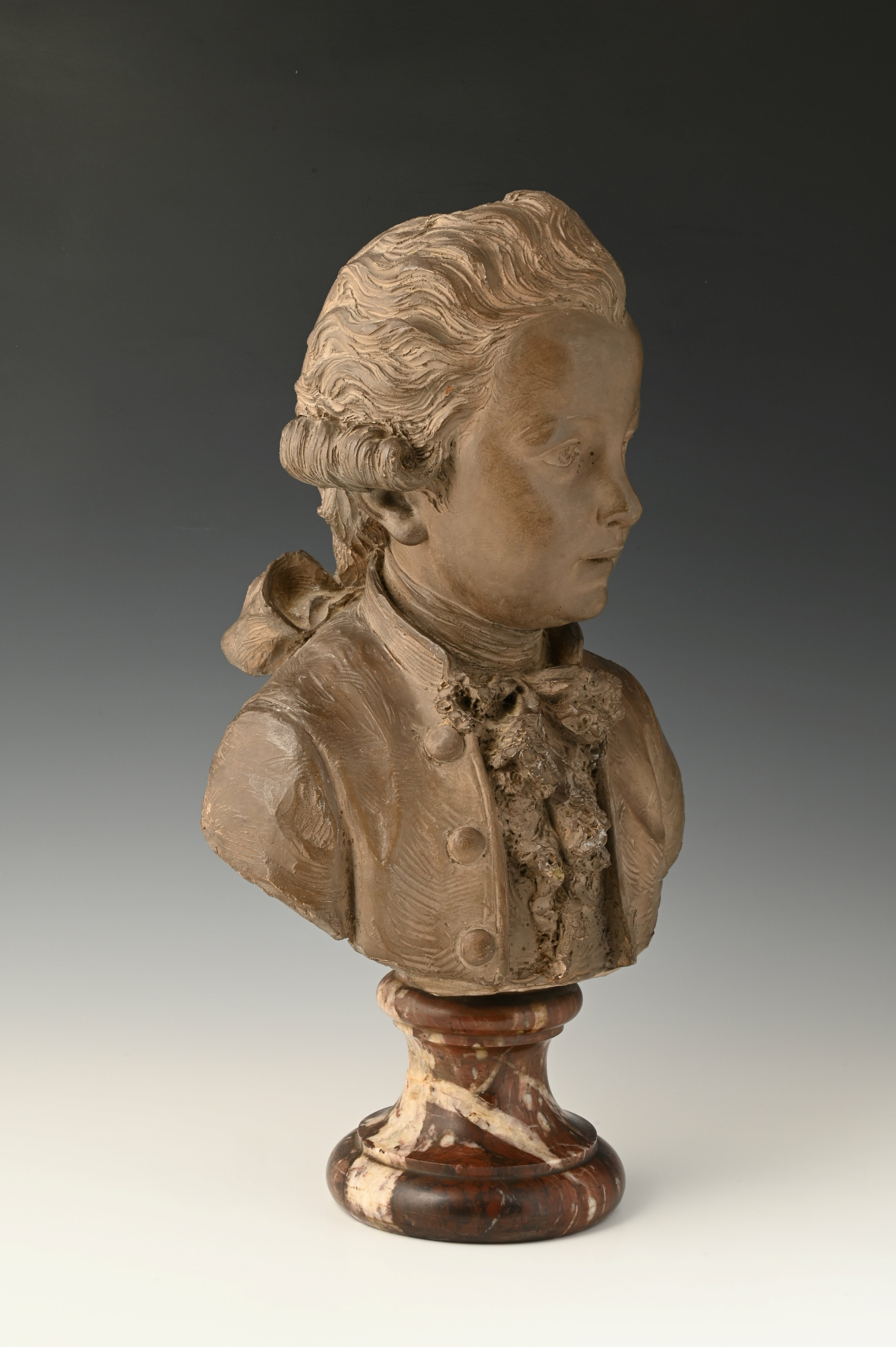

Bust of a Young Boy
- Period:
- 18th century
- Dimensions:
- 44 x 24 x 19 cm
- Reference:
- 100-1006
Price on request
- Share
Bust of a Young Boy
In the Manner of Jean-Antoine Houdon (1741–1828)
This finely executed terracotta portrait bust, conceived in the Louis XVI style, reflects the flourishing period of French sculpture in the final quarter of the 18th century. The work is representative of the growing interest in the individual child portrait, in which children were no longer depicted as miniature adults, but rather with an emphasis on their distinct personality, youthful appearance and natural expression.
This development was partly influenced by the ideas of the Enlightenment, particularly the educational writings of Jean-Jacques Rousseau, which encouraged a renewed appreciation of childhood as a distinct and natural stage of human development.
Terracotta was a highly favoured medium among French sculptors of the period, including Jean-Antoine Houdon (1741–1828), Augustin Pajou (1730–1809) and Jean-Baptiste Pigalle (1714–1785). The plastic qualities of clay allowed artists to model subtle facial features, characteristic hairstyles and intricate costume details with remarkable spontaneity and sensitivity. Terracotta was also particularly well suited to portrait models, studio productions and reproductions based on existing sculptural designs.
The man portrayed wears clothing characteristic of French fashion circa 1770–1785. The open-fronted justaucorps, elaborately decorated waistcoat and richly pleated lace jabot reflect the refined dress culture of the aristocratic and affluent bourgeois circles of the period. The carefully modelled hairstyle, with rolled curls at the sides and a ribbon tied at the nape of the neck, further enhances the elegant and distinguished character of the portrait.
The bust belongs to the broader French portrait tradition of the late Ancien Régime, in which refined craftsmanship, naturalistic characterisation and aristocratic representation were brought together in harmonious fashion.
Its composition and stylistic vocabulary are reminiscent of the portrait sculpture of Jean-Antoine Houdon, whose models enjoyed considerable influence throughout the late 18th and 19th centuries. Such sculptural designs were reproduced in various materials and formats, including through specialised Parisian workshops and manufacturers of terracotta, bronze and biscuit porcelain.


